Intertwined Continent
The future of Canada-US legal engagement


Just over a month into the second Trump administration, Canada-US relations appear to be sliding toward a nadir (one that risks redefining “nadir”). At present, most of those tensions stem from trade in goods, where the Trump administration has imposed tariffs on Canadian aluminum and steel and threatened sweeping, comprehensive tariffs on all Canadian imports into the United States (including energy). The Canadian government has signalled it would then impose its own concomitant tariffs.
These activities would signal the effective end of the Canadian bet on continental economic integration, ending nearly four decades of “free trade” between the two states.
Whether degraded Canada-US trade relations would spill over to other areas of bilateral cooperation remains uncertain (although one need not be much of a pessimist to conclude it would). The CBC recently ran a story about the uncertain future, for instance, of the Colombia River Treaty. The consequences of that treaty’s expiration are considerable (although perhaps most considerable for the United States, given the river’s direction of flow).
More generally, however, the shared residence of Canada and the United States in North America means that dozens of treaties (or other, technically, non-binding agreements) web the states together. The Canada Treaty List database contains 719 such instruments (although this list includes both amendments as well as original instruments, and not all instruments listed in the database are likely still in effect).
The US State Department, in its equivalent reporter series, notes 226 bilateral instruments in effect. These may be categorized as follows in the chart below. Note the number of defence and boundary agreements.
One of these is the Treaty between the United States and the United Kingdom concerning the Canadian international boundary (1908). Somewhat surprisingly, President Trump apparently invoked this treaty in the context of his puzzling campaign questioning the territorial integrity of Canada (most manifestly expressed through his repeated assertions that Canada should/would become the US’s “51st state”).
This 1908 treaty settled several border related issues. What its invocation means for the President is difficult to know, of course. But perhaps it signals a territorial ambition. If so, a whole host of international agreements between Canada and the United States might also be prey to this reignited American land coveting.
It is worth considering, therefore, the range of these agreements.
Given the list of topics below, it seems clear that were the Trump administration to pursue an active legal disengagement with its northern neighbour, the denunciation of these instruments (some of which are decades or even centuries old) would (at minimum) produce a paralyzing new normal in the coordinated, rational governance of a shared continent.
“Move fast and break things” may be a tech company mantra. It is generally not a good idea in the three-dimensional world.
Canada-US Agreements by Subject Area
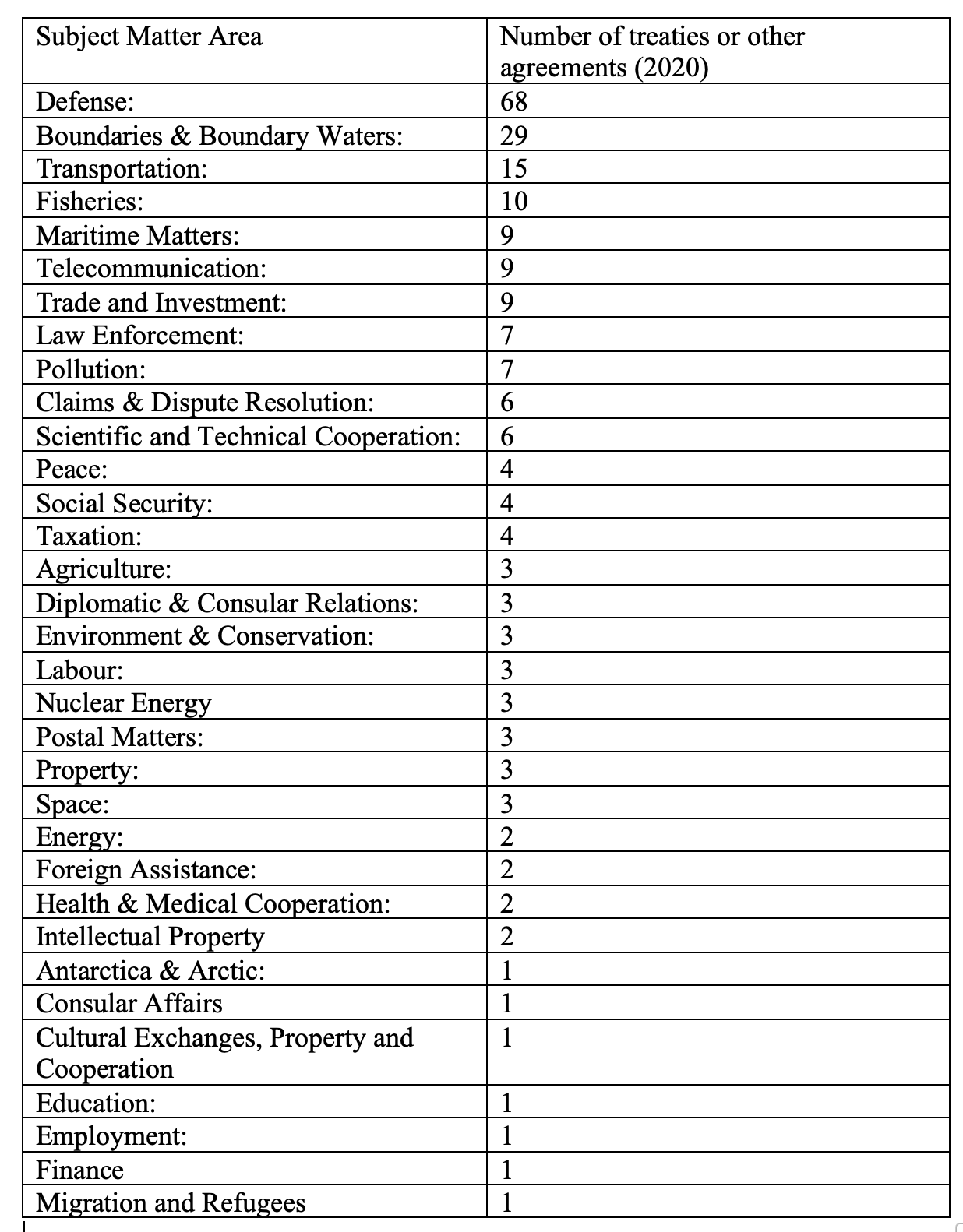
From: United States Department of State, Treaties in Force 2020.